Showing posts with label West Papua. Show all posts

14 January 2011

Torture in Papua: What? A Trial?


The recent past has seen a number of videos of Indonesian soldiers torturing West Papuans have surfaced. One in particular, was especially graphic and gratuitous in the violence being perpetrated against the victims. The publishing of this video should have caused Indonesia significant embarrassment as it has continually claimed that Papuans for the most part want to be a part of Indonesia and that Papua is far less "restive" and "separatist" than the media portray it to be.

Unfortunately, the acute embarrassment that Indonesia feigned at the time passed very quickly. Suggestions that the type of brutality witnessed in the video was unacceptable and that the authorities would investigate fully and prosecute the perpetrators to the full extent of the law were greeted with some degree of skepticism . And, this skepticism has been proven to be justified.

Three Indonesian soldiers have gone on trial for their respective roles in the torture. However, they have not been charged with any offenses relating the physical abuse, the torture, that they committed. Instead they have been charged with disobeying orders.

At a military court hearing in Jayapura the reasons for the charge were laid out in the following terms:

  1. Aside from the video there is no evidence that the three committed any offenses against the victims
  2. The victims refused to submit any statements to the court.

The maximum punishment that could be imposed on the three is 30 months in a military prison.

To suggest that the trial is a whitewash of another dirty chapter in Indonesia's occupation of West Papua is an understatement. The outrages committed against the Papuans rival those committed against the people of Timor Leste. The difference, sadly, is that the UN was complicit in the integration of West Papua into the Republic of Indonesia through its participation in the fraud that was the "Act of Free Choice". It is estimated that almost one-fifth of the West Papuan population have perished during this often bloody occupation.

Yet, any serious consideration of Indonesia's ability to address human rights crimes must note that, the despite the enactment of a human rights law and the establishment of a human rights court, has been very, very, very poor. The President, Susilo Bambang Yudhoyono (SBY), is a former general and a man with many skeletons in his closet that for the most part he has been given a pass on because of the promise he offered for change when elected to the presidency. However, he is also the president that promised a grieving nation that those responsible for the assassination of Munir in 2004 would be brought to justice.


So, the suggestion that the Papuan victims of these more recent outrages would see justice was more "omong kosong". This trial and the litany of failures throughout the SBY first, and now second, terms as president highlight that the President is not in control of the running of his own administration. The "reformasi" (or reformation) period in Indonesia has been like watching a wayang performance where you can clearly see the puppets but never see the puppet master (dalang).

But, I digress. The point is a simple one: for Indonesia, like any other country, to move forward it must face up to the ugliness of its past with respect to the violations of human rights that have been perpetrated against Indonesians. Furthermore, there is a need to not only acknowledge that these outrages are continuing in the present, but to be pro-active in ensuring that they stop.

Free West Papua!

Thus endeth today's rant and rail.

19 October 2010

Independence and Real Free Choice for West Papua!

I have West Papua on my mind today.

I am guessing it is because the news of the past 24 hours with the release of further graphic footage of abuses perpetrated on West Papuans that defy even the most basic standards of dignity and respect for our fellow human beings really bothers me.

But on a brighter note, here is George Telek singing of freedom for West Papua.


Available on YouTube.

Freedom for West Papua!

Freedom for West Papua is long overdue!

Disclaimer:
This post contains graphic footage of torture. Do not click play if you do not want to watch the embedded video.

The Act of Free Choice was nothing more than the granting of an open cheque book to Indonesia to rape and pillage the natural resources, and the people, of West Papua.

The Act of Free Choice was a farce then and remains a farce now. So, to stand idly by and let the universal, and may I add basic, human rights of our brothers and sisters in West Papua to be stripped away without fear or retribution is a sad indictment on all of us as people, as human beings.

You want to see, and understand, why this bothers me so...here, here, here, and watch the graphic torture footage.

I would like to know how this video footage came into the public domain. But it looks real, and I am sorry, but there is nothing that justifies this, absolutely nothing.

04 August 2010

Press Freedom and The Dangers to Journalists...

A free press is often seen as a hallmark of a mature democracy. The simple idea being that a free press in some way ensures that there is accountability and the culture of impunity and immunity is whittled away. However, a free press does not always guarantee the safety of those who wish to expose the excesses of some members of the community through their activism or their reporting. Indonesia has seen three journalists killed since February 2009. The latest, Ardiansyah Matra'is was pulled from a river in West Papua. Matra'is was naked and handcuffed.

Stop killing journalists!

Matra'is prior to his death was a reporter for Merauke TV. Matra'is death is also the culmination of a series of threats SMS-ed to journalists warning them that "if they played with fire they would be sure to get burned" and that they should be 'prepared for death'.

Matra'is' death follows the mysterious death of a Kompas journalist, Muhammad Syaifullah, in Kalimantan. The police have been quick to dismiss foul play, which suggests that the case theory as far as the police are concerned is that this was a suicide. Syaifullah had been reporting on the ongoing raping and pillaging of Indonesia's natural forests and resources by big mining companies.

These two deaths follow the death of Anak Agung Prabangsa of Radar Bali in February 2009. Prabangsa had also been the subject of threats after exposing irregularities in the building of an international standard primary school in Bangli, Bali.

It is time that the free press that is claimed to exist in Indonesia became free. The first step is to ensure that journalists can do their jobs in an environment where they are free from terror and threats of death and, in at least 3 cases in the last 18 months, death.

01 August 2010

The Killing of Yawan Wayeni...

BE ADVISED THE VIDEO CONTAINS GRAPHIC FOOTAGE OF HUMAN RIGHTS ABUSES PERPETRATED BY THE MOBILE BRIGADE OF THE INDONESIAN NATIONAL POLICE FORCE. VIEWER DISCRETION IS ADVISED.


I have had this for a few days (and the LA Times went with this story today) and the news relates to events that happened on 3 August 2009. I have been thinking whether I should post it and what I should say about it. I have 99 followers and average about 21 returning visitors every day (according to my statcounter). So, I am hardly a fountain of influence peddling information. If only I had the numbers that Perez Hilton has or the same number of Twitter followers that Ashton Kutchner has, then maybe what I post might influence opinion a little. But, I firmly believe that the flap of a butterfly's wings can cause a tornado at some point in the future. We must start somewhere, and maybe if each of us does a part we can, together, influence opinion and make the world a better place.

This post does not lend itself to a full expose of the litany of abuses perpetrated against the Papuan people since the integration of Papua into Indonesia in 1963 and the alleged act of free choice in 1969. However, it is important to note that there has been resistance to the integration into Indonesia.

It must also be pointed out that the Indonesian government still tightly controls access to the region. The lack of access by Indonesian human rights NGOs and Indonesian press leads to allegations that the Indonesian government is perpetrating crimes against the Papuans in order to stifle this dissent and eradicate it. It is time that the world took a stance on this issue and called the Indonesians to task. Nevertheless, it is also important that Indonesians themselves said, "enough is enough" and moved to bring their government to account for the ongoing atrocities occurring in Papua.

Perhaps, it is more important that Indonesians take a stand on the brutality being perpetrated against the Papuans as this then prevents the Indonesian government playing the "foreigner" card. The foreigner card is the claim, made generally through Commission I of the Indonesian Parliament, that foreigners leveling accusations of Indonesian brutality in its far-flung and restive provinces is nothing more than international meddling in domestic affairs with a view to securing vast swathes of Indonesia's natural resources for themselves.

The video is the of the killing of Yawan Wayeni. Wayeni was an escaped convict. He had been jailed for alleged violence against police and the burning of police property. He was also said to be a member of the Free Papua Movement or Organisasi Papua Merdeka (OPM). The video is graphic. Wayeni has been bayoneted in the stomach and his killers are taunting him through the final moments of his life.

However, in scenes reminiscent of Braveheart, Wayeni to the end can be seen raising his fist and saying as loud as he can "Papua Freedom" (Papua Merdeka). The video shows the police taunting Wayeni as he lies there. It also shows that they are not rendering him any assistance. Even if the claim was that he was wounded in this way while resisting arrest with a home-made rifle, it is clear that he is no longer any threat. The police must render all assistance they can.

The video was taken by the police. So, it has been leaked. By who, and why, remains a mystery.

It must be noted that, aside from Brimob, the other force most active in the restive province of Papua is the special forces. The special forces known by their Indonesian acronym of Kopassus (Komando Pasukan Khusus) have long been a pariah in world military circles with most countries opting not to engage in any joint activities with them. However, the US has recently indicated that they are about to re-engage with them. Australia has been re-engaged with them since 2005.

This is problematic because this force has long been accused of serious and grave breaches of human rights. These abuses have been perpetrated against the Timorese during Indonesia's occupation of East Timor / Timor Leste, and against the Acehnese during the period of Special Military Operations (DOM / Daerah Operasi Militer) and also against the Papuans. For these alleged abuses the special forces have never been called to account. Re-engaging with them suggests that there is no longer any serious intent on the part of most nations to hold either Kopassus or Indonesia accountable for these violations.

There can be no justice without accountability.

16 July 2010

Is Freeport Mining Uranium in Papua?

There has been talk off the record of this for some time. However, a recent article published in Bintang Papua has brought this out into the open. So, much so that the local government is wanting to start up an investigation. It would seem that the major concern here is not so much the mining itself, but rather the fact that uranium is not one of the minerals or ores that PT Freeport Indonesia, or any of its subsidiaries, is supposed to be extracting from the mineral and ore rich earth of Papua.


The reality is that Freeport has been on sweetheart deals from the outset with consecutive Indonesian governments that have seen the company become incredibly, some might say obscenely, rich at the expense of local Papuans. Another reality is that if Freeport is in fact mining uranium then it would be seemingly doing so in breach of its current work contracts.

This would in very simple terms amount to theft. This breach or theft might not be so easily rectifiable with a payment to silence critics should the local government investigation get off the ground. By secretly mining uranium, Freeport has been avoiding royalties that it would have otherwise had to pay, assuming that a work contract was agreed.

And it is worth noting that uranium is not one of the metals, minerals, or ores that makes an appearance on its logo.

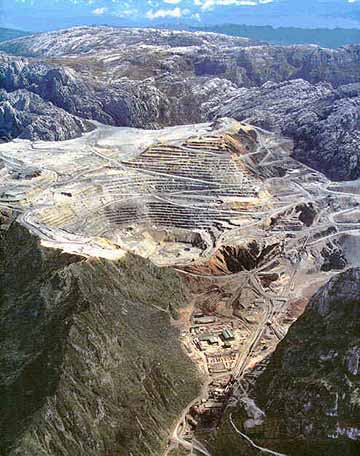
On an environmental note, it is worth noting that uranium is primarily used in nuclear power and weapons development. However, it is difficult to reconcile the idea that Freeport has any serious concerns about the environmental damage that it reeks on the environment or the world. A quick view of the Grasberg operation highlights this extreme lack of concern. The photos here could easily be entitled "Freeport - No Mountain is Too Big!"

Freeport has been a law unto itself almost since its establishment. Initially, this was because Papua was so remote to the rest of Indonesia when Freeport first commenced its operations. Now, because it is considered too important to reign in, and a misguided belief that Indonesia could not afford to enforce legislation that requires foreign companies to sell off stakes to local investors in mining operations nor run it successfully.

The people of Papua deserve better.

24 April 2010

Penis Enlargements and the Indonesian Police Force...

A recent article in The Jakarta Globe draws out some interesting links between penis enlargement, the Indonesian National Police Force (Polri), the separatist movement in Papua, and serving the public. It seems that any man wanting to join up and serve the public as a police officer in Papua will be required to answer a question about whether or not they have had a penis enlargement.

The argument according to the Police Chief, Bekto Suprapto, is that an enlarged penis is a problem during training (and presumably during service). I am sure, if pressed, Suprapto would be willing to elaborate as to exactly what sort of training the police do in Papua that makes an enlarged penis problematic.

However, this poses some interesting questions for recruitment officers as they search to 'enlarge' the ranks of serving police officers. First, is there a set of penis size standards that prospective candidates must meet in order to proceed through the selection process? Then the obvious questions tend to, what is the deal for men who, without treatment, are already well-endowed? And finally, is there a corresponding set of size related criteria for women and the size of their breasts?

In any event, if they do not make the grade as police officers then there is a good chance they might be snapped up by the porn industry where it seems that size is respected as an asset rather than an obstacle.

So, what about the court decision that seemingly reinstates the case against Chandra M Hamzah and Bibit Samad Rianto?

30 July 2009

Australian Travel Advice -- Indonesia -- 30 July 2009


This is the latest travel advice for Indonesia that I have received.

Make of it what you will. The internal links are working when I checked them. What appears below is the overall summary of the advice. I have also cut and pasted the section on terrorism. This section includes a statement that Indonesian authorities have provided information that terrorists may be intending to kidnap foreigners. If you want to read the advice in full, then follow the relevant links.

Summary

  • The World Health Organisation (WHO) has confirmed cases of H1N1 Influenza 09 in a number of countries throughout the world, including Indonesia. For a list of these countries, visit the WHO website. For further information and advice to Australians, including on possible quarantine measures overseas, see our travel bulletin on H1N1 Influenza 09.
  • We advise you to reconsider your need to travel to Indonesia, including Bali, at this time due to the very high threat of terrorist attack.
  • On 17 July 2009, terrorists detonated bombs at the Ritz-Carlton Hotel and the JW Marriott Hotel in Jakarta. Australians were among those killed and injured.
  • There is a possibility of further terrorist attacks in Jakarta and elsewhere in Indonesia, including Bali. In past years, terrorists have attacked nightclubs, bars, restaurants and hotels in Bali and Jakarta. In the wake of the 17 July Jakarta bombings, we judge that these types of venues in Bali and Jakarta are still targets of interest to terrorists.
  • We continue to receive credible information that terrorists could be planning attacks in Indonesia and that Bali remains an attractive target for terrorists. You should exercise great care, particularly around locations that have a low level of protective security.
  • If you do decide to travel to Indonesia, you should exercise extreme caution.
  • Previous terrorist attacks against Westerners in Bali and Jakarta indicate these areas are priority targets. You should take particular care to avoid places known to be terrorist targets. See the Terrorism section for details.
  • Presidential elections were held on 8 July 2009. There were incidents of violence in Papua during the parliamentary elections in April 2009, including attacks on infrastructure. There is a possibility of further attacks, including on infrastructure, in the period surrounding the Presidential elections.
  • Since 11 July 2009 there has been a series of violent attacks near the Freeport Mine in Papua. One Australian has been killed in these attacks. Further violence is possible.
  • Australians should avoid all protests, demonstrations and rallies as they can turn violent.
  • We advise you to read carefully the sections on travel to Aceh, Central Sulawesi Province, Maluku, Papua and West Timor where additional safety risks exist.
  • The World Health Organization (WHO) has confirmed human deaths from avian influenza in Indonesia, including Bali. The Indonesian Government has declared that rabies is present in Bali. See the Health Issues section below for advice to Australians travelling to or resident in Indonesia.
  • You should telephone ahead for an appointment before going to the Australian Embassy (See Where to Get Help).
  • Because of the serious terrorist threat we strongly recommend that you register your travel and contact details with us so we can contact you in an emergency.
  • Be a smart traveller. Before heading overseas:
    • organise comprehensive travel insurance and check what circumstances and activities are not covered by your policy
    • subscribe to this travel advice to receive free email updates each time it's reissued.

Terrorism is a threat throughout the world. You can find more information about this threat in our General Advice to Australian Travellers.

We advise you to reconsider your need to travel to Indonesia due to the very high threat of terrorist attack. Ask yourself whether, given your own personal circumstances, you're comfortable travelling to Indonesia knowing there is a very high threat from terrorism and you may be caught up in a terrorist attack. Ask yourself whether travel could be deferred or an alternative destination chosen. If, having considered these issues, you do decide to travel to Indonesia, you should exercise extreme caution.

On 17 July 2009, terrorists detonated bombs at the Ritz-Carlton Hotel and the JW Marriott Hotel in Jakarta. Australians were among those killed and injured.

There is a possibility of further terrorist attacks in Jakarta and elsewhere in Indonesia, including Bali. In past years, terrorists have attacked nightclubs, bars, restaurants and hotels in Bali and Jakarta. In the wake of the 17 July Jakarta bombings, we judge that these types of venues in Bali and Jakarta are still targets of interest to terrorists.

We continue to receive credible information that terrorists could be planning attacks in Indonesia and that Bali remains an attractive target for terrorists. These attacks could take place at any time. You should be particularly vigilant during holiday periods such as Easter and Christmas.

Indonesian authorities have warned that terrorists may be planning to kidnap foreigners.

Attacks against Westerners in Bali and Jakarta indicate that these areas are a priority target for terrorists. Suicide attacks against locations frequented by foreigners in Bali and Jakarta such as the 1 October 2005 and 12 October 2002 Bali bombings and bomb attack outside the Australian Embassy in Jakarta in September 2004 killed and injured many people. Westerners were also targeted in the bombing of a five-star hotel in central Jakarta in August 2003. We cannot rule out the possibility of another attack targeting Westerners, including Australians.

In planning your activities, consider the kind of places known to be terrorist targets and the level of security provided at venues. You should take particular care to avoid places known to be terrorist targets. Tourist areas and attractions throughout Indonesia and tourists travelling to or from these places, including those in tour groups or tour buses, could be targeted. Other possible targets include international hotels, clubs, sporting clubs and venues, restaurants, international fast food outlets, bars, nightclubs, cinemas, theatres, Jakarta's embassy district and diplomatic missions elsewhere, international schools, expatriate housing compounds and Western interests and businesses. Places frequented by foreigners, central business areas, office buildings, churches and other places of worship, airlines, airports, public transport and transport hubs, shopping centres, premises and symbols associated with the Indonesian Government, and outdoor recreation events are also potential targets.

Due to security concerns, security at the Australian Embassy in Jakarta and the Consulate-General in Bali is at a high level. The Australian Embassy has advised its staff and their families to be particularly careful in how they travel or walk to and from the Embassy.

22 November 2008

HIV / AIDS, Microchips, and Papua


The Papuan Provincial Government has drafted a Regional Regulation that includes an article that requires certain people living with HIV / AIDS to be micro-chipped. This seems to fly in the face of other measures that Indonesia has taken to reduce the stigma associated with being HIV positive. Indonesia has laws and regulations in place that make it illegal to discriminate against people living with HIV / AIDS in the work place and the general community.

The article defines "certain" people as being those that are "aggressive". Aggressive in the context of the regulation are those that are aggressively seeking out sexual partners and presumably spreading the virus without informing their prospective partners of their HIV status.

I am not sure how the microchips are going to prevent the aggressive individuals that are so micro-chipped from having sexual intercourse or infecting others. At best the microchips will allow authorities to track movements and general locations where these aggressive people are. I just do not see how the microchips will alert a potential victim to the HIV status of the micro-chipped person.

The idea of chipping aggressive people is just so subjective in nature that it is difficult to see how it can possibly work without falling foul of the constitutional provisions prohibiting discrimination. Who is to decide what constitutes aggressiveness and how is aggressiveness to be measured?

There is something that seems to be inherently wrong in tagging people within certain groups. I wonder how long it will be until there are regional regulations that require the micro-chipping of people from marginal groups such as the homeless, minority faiths, gays and lesbians, expatriates, to name but a few.

I am sensing that there will undoubtedly be plenty of concerned citizens and NGOs that will band together to challenge the validity of the regional regulation. Tagging people is just wrong, at least, to my mind.

10 November 2008

The Pornography Law -- A Dead Document?

The Jakarta Post recently reported that Constitutional Law Expert, Irman Putra Sidin, saying, "How can we expect the law to be implemented when people and officials oppose it? Who's going to enforce it? It will end up as merely a dead document," based on the fact that at least four provinces were going to actively oppose the law and refuse to enforce it. Those provinces are Bali, North Sulawesi, Yogyakarta, and West Papua.

The rationale for this position is that if the law is not implemented nationwide then can it be valid anywhere. I would have thought that once the law was passed by parliament and enacted as law then it was the law of the land. Therefore, in a republic like the Republic of Indonesia, the law would apply everywhere.

A more interesting argument would be does the refusal to implement the law amount to the beginning of an act of secession? How far do the provinces want to push this? What sanctions could the State impose on rogue provinces that refuse to enforce state laws and regulations.

In fact this should be read as a preliminary movement towards seeking independence from the Republic of Indonesia. Quite clearly the intent of West Papua is to secede from the Republic if they are required to enforce the law. Andrikus Mofu, spokesperson for the West Papuan delegation said the following, "We will inform the international community of our aspiration and our intention to separate from Indonesia." This seems to leave little doubt where the West Papuan intentions lay.

The most likely course of action will be a Constitutional Court challenge to test the binding nature and legality of the provisions. The definitions of pornography and the manner that pornography is to be determined is arguably loose. Nevertheless, this is an issue that the Court will be asked to determine.

The reality is the laws of the land are to be applied and all are to be equal before the law. Special dispensation in one province compared to another means that there is no equality before the law and this is more likely to lead to problems than the enforcement of the law.

Of all the things that could trigger the disintegration of the Republic it is interesting that it is the Pornography Law that is being talked about as being this trigger.