Musings about the law, politics, culture, people, education, teaching and life. An independent voice and an independent perspective - Carpe Diem!
Showing posts with label Economic Affairs. Show all posts
05 January 2011
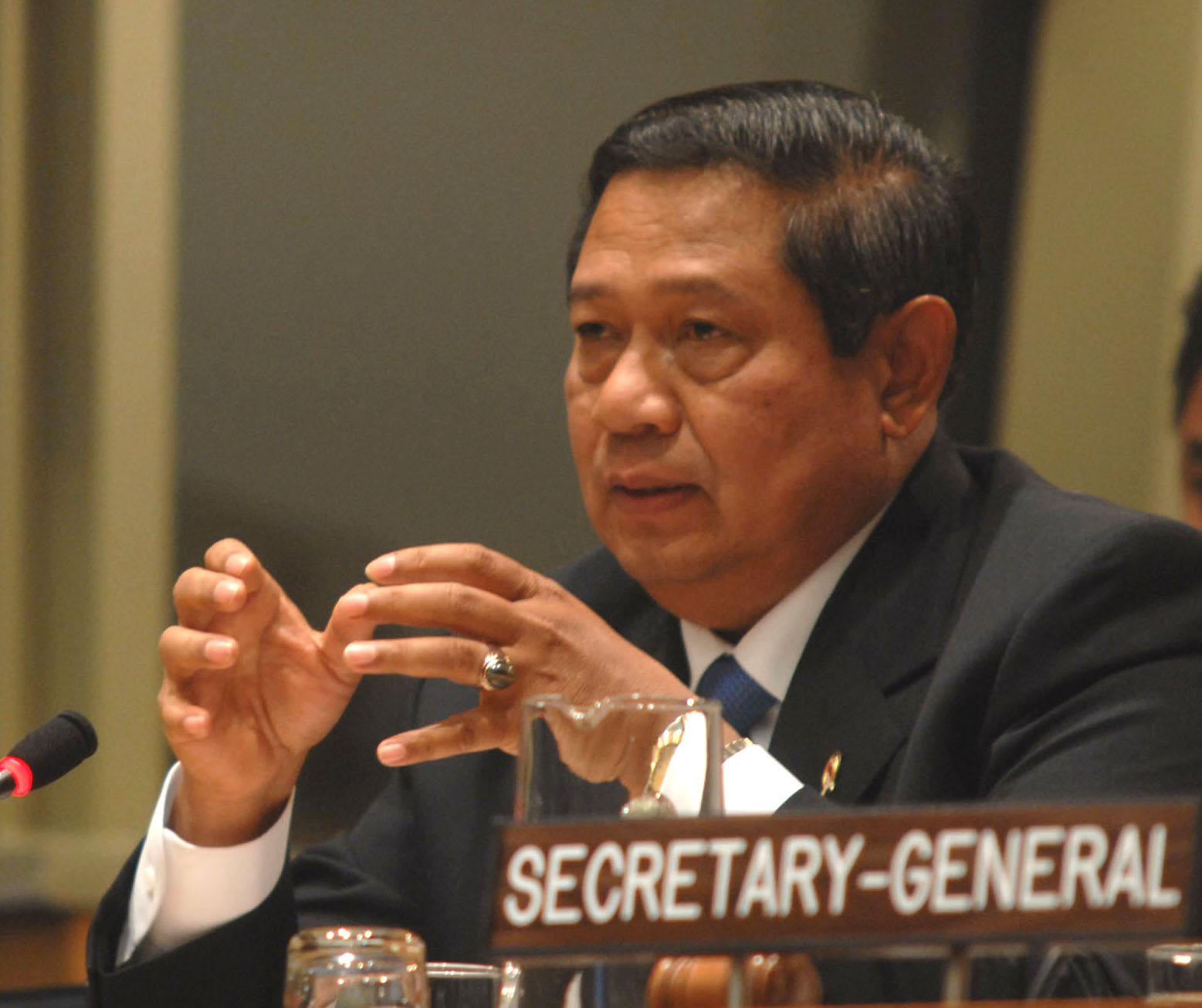
SBY and the English Language...
It has been a while since I have felt like writing a post about SBY, but not being one to pass up an opportunity to "bang on" about what a fraud the man has turned out to be as president, I figure that this story is as good as any to get started on. The president's spokesperson for international affairs, Teuku Faizasyah, has had to defend the president's use of English in a speech to an Indonesian audience at the Stock Exchange building recently.
There are a few legal issues to be considered here in light of Law No. 24 of 2009 (which you can read about here). However, in a more practical sense the real issue is why does the president need to use English at all in the context of a speech on the economy to an Indonesian audience? Admittedly, there will be the odd loan or borrowed term from English that is similar or even the same in Indonesian. Yet, on the whole, most English words, even some of the loan and borrowed ones, have Indonesian equivalents.
But back to the gist of the story, according to Faizasyah, the president felt the need to use English as a means of clarifying some difficult economic concepts. Now, with all due respect, he is making a speech at the stock exchange and on the whole the majority of those employed there are going to have a whole lot more knowledge of all things economy-related than the president. So, exactly what was he trying to clarify? The idea that the speech was intended for a broader audience is not borne out by those in attendance.
The majority of the speech was in Indonesian and some English words were thrown in. So, to suggest that the words were used to remind people of the foreign roots of the concepts is a furphy at best. At worst it suggests that Indonesia is behind the game when it comes to all things economy-related and therefore the English has to be used. If I was Indonesian, I would probably be offended with the suggestion that I was not as smart as those economists in the West.
Perhaps the real reason that the president uses English in these speeches is that he feels that he is intellectually inferior to his audience and he is trying to mask that intellectual inferiority by pretending to be knowledgeable in the use of the English language.
Or maybe he is angling for a job on the world stage. After all, it was not all that long ago that the Indonesian Democrat Party was suggesting that the president was a serious contender for the job of United Nations Secretary General. So, maybe the use of English is an attempt to convince people that he really is an international statesman.
In any event, there does not appear to be a legitimate or even an arguable, reason for the president to use English in the speech he gave at the Indonesian Stock Exchange.
I wonder if in hindsight Indonesians are beginning to wonder whether SBY was the right choice for a second term as President of the Republic of Indonesia?
08 August 2010
The Indonesian Economy -- A Reality Check!
This post is unashamedly cut and pasted from my good mate "treeatwork". I wrote something about the same subject matter, and having read Tree's take on things, I realise that my effort was wholly inadequate.
This piece by Tree will enlighten you for sure.
Enjoy...
The bureaucracy is a circle from which no one can escape. Its hierarchy is a hierarchy of knowledge.
~Karl Marx, Critique of Hegel’s Philosophy of Right
There was a glowing review of Indonesian economy in the New York Times the other day. The economy is growing at 6.2%, the stock market at record high and foreign direct investment up 51%. The President, who was holding a cabinet retreat cited these numbers and applauded his own government for having achieved them. He remains hopeful that the future will be better and so is the rest of us.
Looking ahead however, it pays to be more cautious and I am particularly worried about a few things.
Deindustrialization. I heard Faisal Basri used this expression and it’s probably most accurate. In terms of its industrial output, it does look like Indonesia is on a path towards deindustrialization. For an economy of this size, Indonesia is struggling to meet its own needs and being so close to the global giants – China and India on either side – Indonesia is expecting an import glut.
The Nationalist politicians – and economists – were quick to argue for more protectionism and blame globalization, no less than the Coordinating Minister for the Economi Hatta Radjasa was heard proposing some sort of renegotiation on the AFTA agreements.
For such a proud country, this defeatism mentality is worrying. It almost looks as if Indonesia is totally unprepared to be competitive, despite all of its promises and recent successes.
In leading the country for prosperity, Indonesian policy makers remains almost always in a defensive posture, completely lacking any initiative or even desire, to be competitive. During a period where Indonesia was one of only three growing economies in the world, the resilience was comforting and yet the monetary authority – Bank Indonesia – failed to effectively lower interest rate to some more decent level.
This is a recognized problem and the importance of managing the interest rate was again reiterated and prioritized during the confirmation hearing for the Governor of Bank of Indonesia last week in DPR.
The interest rate is now at some 6.5% - but effective rate is closer to 9%, for some reason Bank Indonesia lost control of this a while ago. Growth is paced at some 6% so presumably it leaves some room, except that with inflation higher than expected in this quarter – now estimated at 6.2% - I’m wondering what sort of monetary acrobats will be performed now to expect Bank Indonesia to do now what it had been unable to do in the few months?
The fact that Indonesia remains a high cost economy is probably the most critical of its shortcomings. The tax code is overwhelmingly complicated and scandalously unreliable. Massive, systematic graft involving blue chip companies and large state owned enterprises is a regular feature on the headlines. As an instrument of growth, the tax code is getting to a point where its ridiculousness prohibits growth and effectively hampers future potentials.
Most recently the tax office introduced a new VAT for e-commerce transaction. I made a few calls to check if anyone have any figures, how much exactly do the government expect to earn from an E Commerce Tax but nobody seems to know the size of the market. For most of the local players, the wealth of internet transaction remains elusive. Fresh tax will make it even less attractive. For all the promises of a domestic technology industry, the Indonesian Government is pretty much ready to nip it in the bud.
Red tape and bureaucracy in Indonesia is at par with third world communist countries like Cuba and Vietnam – and it’s not getting any better. Nowhere to be competitive in a global market, particularly when placed in a region with serious competition from countries like Hongkong, Singapore, Taiwan and Australia.
On the budget side, the economy has its own problems. Most ridiculously, I’d point to the failure of the Government to actually execute the budget. Being a third world country and all, we could forgive Indonesia for being unable to afford a Formula One track or to build a decent sewage system – those things cost money and Indonesia don’t really have that much money.
However, when the Government failed to spend the money that they already have and authorized to have, that’s a whole different kind of failure. For the first quarter of 2010, this failure of the Government TO SPEND money is costing Indonesia minus 0.6% so far (H1, 2010, 32.7% budget realized)
Over the years, Indonesia consistently failed to build proper infrastructure to support growth – harbors and roads to enable exports, market infrastructure etc – year after year the successive government failed to meet their own targets for building infrastructure and this only adds to the high cost economy.
The need for infrastructure in China, for example, was recognized early on and the Chinese government – unburdened with Democracy – pushed for gigantic infrastructure upgrade across the Nation. Singapore is smaller than Jakarta so it’s probably easier but even to a comparable geographical size Indonesia failed completely. Jakarta is in danger of failing completely on regular basis with flood, traffic jam and lack of decent public transport. The traffic jam of Jakarta alone is costing Indonesia IDR 47T – USD 4bn – and minus 0.5% growth, annually.
The meeting with the President this week recognized these problems and specific instructions were issued to accelerate government spending for infrastructure and special industries.
The instructions – which were read out loud during the press conference – were telling. Among them, the President reminded the Governors that they are really, actually, are part of a National Government. The President elaborated specially that Indonesia is not a federation of smaller nations and all regional leaders are really part of the local government.
Obviously there have been some serious mix up earlier and the importance of governing was lost in the confusion. This is expensive.
Several Presidential Decrees were tabled for revisions, at least one of them specifically dealing with the cumbersome procurement procedures for state apparatus. The bureaucracy is eating into itself and the Government now feels the pain.
The truth is, much of Indonesia’s recent economic numbers is probably nowhere near as good as what it seems. The largest chunk of the growth comes from consumer spending – last year’s good news was adrenaline fueled with the world’s largest democratic election. The globally enforced rapid rate cut (for Indonesia, from the high teens two years ago) introduced the much needed jump of optimism and the celebration put a gloss over the less handsome side.
Unemployment remains high – Indonesian industry grows not fast enough to employ the productive age – so as the working class make more money than before, there are also more people without jobs out there. Tax collection remains woefully low. Some political elites – an economist – warn against foreign debts but the truth is, Indonesian debt in proportion to the budget is not getting any worse.
Presumably, the same elites are willing to pay more taxes to finance growth but so far this is an unreliable conviction. While the number of registered tax payers climbed over the years, large conglomerates and even state owned enterprises remains opaque and worrisome in their corporate behavior.
Groups like the Bakrie group were free to enjoy various special treatments from the Government while at the same time imposing a preposterous amount of burden on the national budget. The Lapindo disaster in East Java is an ongoing national catastrophe and there’s no end in sight in how to compensate for the expenses incurred. At the same time, a group of Bakrie families were caught in a serious scandal of misrepresentation of their financial statement, at some USD8bn I’d hazard that this isn’t merely an accounting error.
If the government had somehow lost control over the private sector for however reason, it’s also losing control upon its own definitive role to govern and impose law and order. Indonesian DPR managed to pass only four out of more than 70 proposed legislations this term. The ridiculous got an upgrade when DPR decides now that they are installing a finger printing system for the honorable members – presumably to ensure their presence in chambers.
Dealing with this seemingly systematic failure, it’s hard not to worry, if the Government really is able to do what it says it will do. It’s August now and we have only five more months in 2010, with a looming price increase and a holiday season in sight. The holiday season will just make consumer spending go higher but eventually they would have to go back to work and face higher prices later.
The electricity price hike was announced last month but quickly revised – the industry lobby claimed the hike was unrealistic and would eventually fueled inflation, the Government blinked and it’s now back to the drawing table.
The price for basic staples were substantially higher, even before the holiday, part weather and part superstitious. This country doesn’t always make sense and it’s just getting harder to believe its promises.
This piece by Tree will enlighten you for sure.
Enjoy...
The bureaucracy is a circle from which no one can escape. Its hierarchy is a hierarchy of knowledge.
~Karl Marx, Critique of Hegel’s Philosophy of Right
There was a glowing review of Indonesian economy in the New York Times the other day. The economy is growing at 6.2%, the stock market at record high and foreign direct investment up 51%. The President, who was holding a cabinet retreat cited these numbers and applauded his own government for having achieved them. He remains hopeful that the future will be better and so is the rest of us.
Looking ahead however, it pays to be more cautious and I am particularly worried about a few things.
Deindustrialization. I heard Faisal Basri used this expression and it’s probably most accurate. In terms of its industrial output, it does look like Indonesia is on a path towards deindustrialization. For an economy of this size, Indonesia is struggling to meet its own needs and being so close to the global giants – China and India on either side – Indonesia is expecting an import glut.
The Nationalist politicians – and economists – were quick to argue for more protectionism and blame globalization, no less than the Coordinating Minister for the Economi Hatta Radjasa was heard proposing some sort of renegotiation on the AFTA agreements.
For such a proud country, this defeatism mentality is worrying. It almost looks as if Indonesia is totally unprepared to be competitive, despite all of its promises and recent successes.
In leading the country for prosperity, Indonesian policy makers remains almost always in a defensive posture, completely lacking any initiative or even desire, to be competitive. During a period where Indonesia was one of only three growing economies in the world, the resilience was comforting and yet the monetary authority – Bank Indonesia – failed to effectively lower interest rate to some more decent level.
This is a recognized problem and the importance of managing the interest rate was again reiterated and prioritized during the confirmation hearing for the Governor of Bank of Indonesia last week in DPR.
The interest rate is now at some 6.5% - but effective rate is closer to 9%, for some reason Bank Indonesia lost control of this a while ago. Growth is paced at some 6% so presumably it leaves some room, except that with inflation higher than expected in this quarter – now estimated at 6.2% - I’m wondering what sort of monetary acrobats will be performed now to expect Bank Indonesia to do now what it had been unable to do in the few months?
The fact that Indonesia remains a high cost economy is probably the most critical of its shortcomings. The tax code is overwhelmingly complicated and scandalously unreliable. Massive, systematic graft involving blue chip companies and large state owned enterprises is a regular feature on the headlines. As an instrument of growth, the tax code is getting to a point where its ridiculousness prohibits growth and effectively hampers future potentials.
Most recently the tax office introduced a new VAT for e-commerce transaction. I made a few calls to check if anyone have any figures, how much exactly do the government expect to earn from an E Commerce Tax but nobody seems to know the size of the market. For most of the local players, the wealth of internet transaction remains elusive. Fresh tax will make it even less attractive. For all the promises of a domestic technology industry, the Indonesian Government is pretty much ready to nip it in the bud.
Red tape and bureaucracy in Indonesia is at par with third world communist countries like Cuba and Vietnam – and it’s not getting any better. Nowhere to be competitive in a global market, particularly when placed in a region with serious competition from countries like Hongkong, Singapore, Taiwan and Australia.
On the budget side, the economy has its own problems. Most ridiculously, I’d point to the failure of the Government to actually execute the budget. Being a third world country and all, we could forgive Indonesia for being unable to afford a Formula One track or to build a decent sewage system – those things cost money and Indonesia don’t really have that much money.
However, when the Government failed to spend the money that they already have and authorized to have, that’s a whole different kind of failure. For the first quarter of 2010, this failure of the Government TO SPEND money is costing Indonesia minus 0.6% so far (H1, 2010, 32.7% budget realized)
Over the years, Indonesia consistently failed to build proper infrastructure to support growth – harbors and roads to enable exports, market infrastructure etc – year after year the successive government failed to meet their own targets for building infrastructure and this only adds to the high cost economy.
The need for infrastructure in China, for example, was recognized early on and the Chinese government – unburdened with Democracy – pushed for gigantic infrastructure upgrade across the Nation. Singapore is smaller than Jakarta so it’s probably easier but even to a comparable geographical size Indonesia failed completely. Jakarta is in danger of failing completely on regular basis with flood, traffic jam and lack of decent public transport. The traffic jam of Jakarta alone is costing Indonesia IDR 47T – USD 4bn – and minus 0.5% growth, annually.
The meeting with the President this week recognized these problems and specific instructions were issued to accelerate government spending for infrastructure and special industries.
The instructions – which were read out loud during the press conference – were telling. Among them, the President reminded the Governors that they are really, actually, are part of a National Government. The President elaborated specially that Indonesia is not a federation of smaller nations and all regional leaders are really part of the local government.
Obviously there have been some serious mix up earlier and the importance of governing was lost in the confusion. This is expensive.
Several Presidential Decrees were tabled for revisions, at least one of them specifically dealing with the cumbersome procurement procedures for state apparatus. The bureaucracy is eating into itself and the Government now feels the pain.
The truth is, much of Indonesia’s recent economic numbers is probably nowhere near as good as what it seems. The largest chunk of the growth comes from consumer spending – last year’s good news was adrenaline fueled with the world’s largest democratic election. The globally enforced rapid rate cut (for Indonesia, from the high teens two years ago) introduced the much needed jump of optimism and the celebration put a gloss over the less handsome side.
Unemployment remains high – Indonesian industry grows not fast enough to employ the productive age – so as the working class make more money than before, there are also more people without jobs out there. Tax collection remains woefully low. Some political elites – an economist – warn against foreign debts but the truth is, Indonesian debt in proportion to the budget is not getting any worse.
Presumably, the same elites are willing to pay more taxes to finance growth but so far this is an unreliable conviction. While the number of registered tax payers climbed over the years, large conglomerates and even state owned enterprises remains opaque and worrisome in their corporate behavior.
Groups like the Bakrie group were free to enjoy various special treatments from the Government while at the same time imposing a preposterous amount of burden on the national budget. The Lapindo disaster in East Java is an ongoing national catastrophe and there’s no end in sight in how to compensate for the expenses incurred. At the same time, a group of Bakrie families were caught in a serious scandal of misrepresentation of their financial statement, at some USD8bn I’d hazard that this isn’t merely an accounting error.
If the government had somehow lost control over the private sector for however reason, it’s also losing control upon its own definitive role to govern and impose law and order. Indonesian DPR managed to pass only four out of more than 70 proposed legislations this term. The ridiculous got an upgrade when DPR decides now that they are installing a finger printing system for the honorable members – presumably to ensure their presence in chambers.
Dealing with this seemingly systematic failure, it’s hard not to worry, if the Government really is able to do what it says it will do. It’s August now and we have only five more months in 2010, with a looming price increase and a holiday season in sight. The holiday season will just make consumer spending go higher but eventually they would have to go back to work and face higher prices later.
The electricity price hike was announced last month but quickly revised – the industry lobby claimed the hike was unrealistic and would eventually fueled inflation, the Government blinked and it’s now back to the drawing table.
The price for basic staples were substantially higher, even before the holiday, part weather and part superstitious. This country doesn’t always make sense and it’s just getting harder to believe its promises.
30 June 2009
Sri Mulyani Indrawti -- Governor of the Indonesian Central Bank?

Politics in Indonesia is a strange animal and even stranger are the motivations of those that play. The latest rumor or perhaps a little more than rumor now that the incumbent president, Susilo Bambang Yudhoyono or SBY to his friends, has said that he is considering it, is the selection of Sri Mulyani Indrawati (photo) as the prospective Governor of Bank Indonesia (Indonesia's Central Bank).
Sri Mulyani is one of SBY's best performing Ministers, if not his best performing Minister. She holds the Finance Portfolio and since the former Coordinating Minister of Economic Affairs, Boediono, was appointed to Bank Indonesia, she has held that portfolio as well.
She is a world class reformer and has made significant inroads into reforming the bureaucracy. She is generally considered to have been successful in her role and been a driving force in cleaning up her department.
Why is it that her appointment to Bank Indonesia is problematic when Bank Indonesia is also an institution that could benefit from her reforming ways? Well, the move reeks of marginalizing the competition and a real shaker and mover on the agenda of reform. A move to Bank Indonesia takes Sri Mulyani out of the majority of the policy areas that she has been so intimate and successful in to date. Almost certainly leading to a waning of her influence in real and broad reforms.
The move is a backward step for those interested in the bureaucratic reform of government. This is not to say that there are not worthy candidates to replace her, there are. This is a backward step because whoever replaces her would have to work twice as hard to develop the gravitas she has acquired during her time in the position. If SBY, and Boediono, are serious then the most sensible move would be, assuming SBY and Boediono win the presidency and vice-presidency, is to make Sri Mulyani the Coordinating Minister of Economic Affairs in the next SBY Government.
There is little doubt that Sri Mulyani would be appointed to the position of Governor of Bank Indonesia if she were proposed as a candidate. Her confirmation through the Indonesian House of Representatives (DPR) would not likely encounter much resistance, if any.
Labels:
Bank Indonesia,
Boediono,
Bureaucratic Reform,
DPR,
Economic Affairs,
Finance,
Governor,
Indonesia,
Policy,
Politics,
President,
SBY,
Sri Mulyani Indrawati,
Susilo Bambang Yudhoyono,
Vice President
Subscribe to:
Posts (Atom)