I guess I am having an unhealthy night...
New York City under the guidance of Mayor Michael Bloomberg banned smoking in bars, restaurants, and other public indoor areas way back in 2002 (has he been in the big seat that long already?). This caused a little bit of a public outcry about the trampling of smoker's rights. However, that has seemingly passed. Nevertheless, it has taken the Bloomberg administration a very long time to become emboldened enough to take the next step and ban smoking in open public spaces.
Bloomberg has signed a law that bans smoking in all city parks, beaches, public plazas and boardwalks. If you get caught smoking in any of these places once the law comes into full force and effect, in about 90 days, there is a USD 50 fine. I am a non-smoker, so in the big scheme of things a ban of this nature bothers me nought. Yet, the reasoning for the ban is to protect non-smokers from the dangers of passive smoking. Now, I am sure most people can appreciate that passive smoking or being forced to suck-up the second-hand smoke from a smoker's cigarette in a confined space like a bar or restaurant is considerably different from smoking in a large open space like a beach.
I am no scientist, or chemist for that matter, but is second-hand smoke in a large public place a serious threat to non-smokers? On a slightly different tangent. Where are smokers going to be able to light up their cancer sticks and take the years off their collective lives?
After all, if I am not mistaken, tobacco is a legal product and those who wish to indulge in the habit are, and must be, allowed to do so. So, I wonder, where does Mayor Bloomberg and his health-conscious pencil-pushing tobacco banners proposing that cigarette smokers go to feed their nicotine cravings? Is the expectation that smoking becomes an exclusively home-based activity? Then again, perhaps the next smoking law will ban smoking in all private homes where their are children present.
I have always been intrigued by the argument that smoking is a human right and that restricting where it can occur is tantamount to violating the civil liberties of smokers. I am not quite sure where the balance is for those who do not smoke. So, do the human rights of smokers trump the human rights of non-smokers?
Considering, the ongoing onslaught against smokers to reduce the places where they can indulge, perhaps the answer is to take the plunge and go the whole nine yards; make smoking illegal, make tobacco illegal.
Musings about the law, politics, culture, people, education, teaching and life. An independent voice and an independent perspective - Carpe Diem!
Showing posts with label Bars. Show all posts
26 February 2011
05 August 2010
The World According to Americans -- An Alternative View...
No offense intended...
I have spent a fair bit of time in the US, North Carolina to be precise, I went to school there (at least part of my university education was there). I have lots of friends and colleagues who I respect and care for deeply and greatly.
Yet, when I started coming across these maps it reminded me of an incident in a pub in Chapel Hill, North Carolina, called "He's Not Here!" The pub got its name from one of the bar tends who would always respond to any phone call looking for a mate with, "he's not here!"
But, my friends, enough of the reminiscing and that is not the story. My mates and I (men and women, US and Non-US citizens were having a quiet Sunday arvo beer and playing some darts at He's Not Here. It had become a game of "The Brits" vs. "The Colonists" with the Aussies and Yankies being the colonists, and the Poms being the other side. Bloody competitive sport darts is after a few beers.
Anyways, we had been playing for a while, enjoying ourselves, and knocking back the beers from these excessively large 32oz blue plastic cups. Then our moment was rudely interrupted by a couple of unknowns who had deduced from our accents that the majority of us were not from around those parts. Good observation. I had a sense that things would go down hill from there so I buggered off to the bar, after all it was my shout.
But, before I could beat my hasty retreat one of the interlopers asked where I was from. I proudly said Australia! To which this rocket scientist replies, "so, how do you find it to be able to take train trips all throughout Europe?" At this point, I turned on my heel (no pun intended seeing North Carolina is the Tar Heel State) and went to the bar shaking my head!
So, that my friends, is the reason I post another of the maps of the World According to Americans for your viewing pleasure.
I have spent a fair bit of time in the US, North Carolina to be precise, I went to school there (at least part of my university education was there). I have lots of friends and colleagues who I respect and care for deeply and greatly.
Yet, when I started coming across these maps it reminded me of an incident in a pub in Chapel Hill, North Carolina, called "He's Not Here!" The pub got its name from one of the bar tends who would always respond to any phone call looking for a mate with, "he's not here!"
But, my friends, enough of the reminiscing and that is not the story. My mates and I (men and women, US and Non-US citizens were having a quiet Sunday arvo beer and playing some darts at He's Not Here. It had become a game of "The Brits" vs. "The Colonists" with the Aussies and Yankies being the colonists, and the Poms being the other side. Bloody competitive sport darts is after a few beers.
Anyways, we had been playing for a while, enjoying ourselves, and knocking back the beers from these excessively large 32oz blue plastic cups. Then our moment was rudely interrupted by a couple of unknowns who had deduced from our accents that the majority of us were not from around those parts. Good observation. I had a sense that things would go down hill from there so I buggered off to the bar, after all it was my shout.
But, before I could beat my hasty retreat one of the interlopers asked where I was from. I proudly said Australia! To which this rocket scientist replies, "so, how do you find it to be able to take train trips all throughout Europe?" At this point, I turned on my heel (no pun intended seeing North Carolina is the Tar Heel State) and went to the bar shaking my head!
So, that my friends, is the reason I post another of the maps of the World According to Americans for your viewing pleasure.
Labels:
Australia,
Bars,
Beer,
Britain,
Education,
Europe,
Funny Stuff,
Good Stories,
North Carolina,
Pubs
03 August 2010
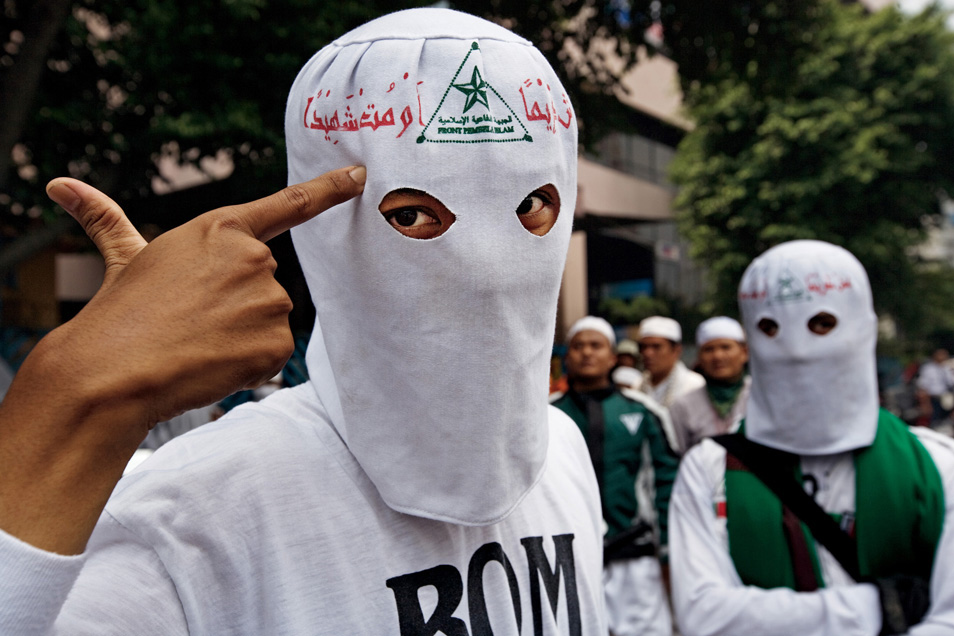
The FPI and Promises of a Raid-Free Ramadan...
Now, here's a deal...the Islamic Defenders' Front (FPI) has informed the government of Jakarta that they will not undertake any raids of nightspots or entertainment venues provided that the government uphold the prevailing laws and regulations that apply during Ramadan. In particular, the FPI have been referring to a 2004 bylaw which regulates trading hours for bars, clubs, and other entertainment venues, such as pool halls.
The problem with this claim by the FPI is that it just is simply not going to be the case for the whole month. Hopefully, I will be eating humble pie come the end of Ramadan and stating unequivocally that the FPI have done as they said and kept their robes, balaclavas, sticks and stones in the cupboard and let law enforcement do their job. Truth be told, law enforcement do their job every year, but it has never been enough to satisfy the FPI in the past so it is hard to imagine that it will be any different this year.
Traditionally, and almost like clockwork, the FPI goons come out en masse and select an entertainment venue to trash based on a bogus claim that the venue is operating outside the provisions of the law.
If Ramadan is about restraint and purification of one's soul through reflection and prayer, then it would make more sense for the FPI to show a little tolerance and restraint, and rather than smashing up bars and clubs spend a little more time on reflection and prayer.
Meanwhile, here are a few photos for your viewing pleasure of various venues and random people in bars and clubs throughout Jakarta. And a couple of photos of the FPI in action throughout the archipelago.
These are the viewing pleasure photos...
The problem with this claim by the FPI is that it just is simply not going to be the case for the whole month. Hopefully, I will be eating humble pie come the end of Ramadan and stating unequivocally that the FPI have done as they said and kept their robes, balaclavas, sticks and stones in the cupboard and let law enforcement do their job. Truth be told, law enforcement do their job every year, but it has never been enough to satisfy the FPI in the past so it is hard to imagine that it will be any different this year.
Traditionally, and almost like clockwork, the FPI goons come out en masse and select an entertainment venue to trash based on a bogus claim that the venue is operating outside the provisions of the law.
If Ramadan is about restraint and purification of one's soul through reflection and prayer, then it would make more sense for the FPI to show a little tolerance and restraint, and rather than smashing up bars and clubs spend a little more time on reflection and prayer.
Meanwhile, here are a few photos for your viewing pleasure of various venues and random people in bars and clubs throughout Jakarta. And a couple of photos of the FPI in action throughout the archipelago.
These are the viewing pleasure photos...
Labels:
Bars,
Clubs,
Discos,
FPI,
Front Pembela Islam,
Full-Frontal Nude,
Indonesia,
Sexy,
Stadium,
Tits,
Violence
22 August 2009
Jakarta Night Life & Ramadan...

The government of Jakarta has suggested that private organizations and others (I am guessing that the government may be thinking about the track record of organizations like the Front Pembela Islam / FPI, among others) must not attack entertainment venues (bars, clubs, discos, massage parlours, and karaoke, among others) or other controversial businesses during the fasting month of Ramadan. It will be interesting to see whether these organizations heed this warning and what the government will do if they do not heed the warning.
The government has issued strict guidelines with regards to operational hours for places that are permitted to open. However, it is clear that community or other forms of vigilante justice are not the way to deal with recalcitrant entertainment venues. The police have a mandate to deal with entertainment venues who fail to comply with the prevailing laws and regulations.
The reality is that most of these organizations do not believe that the police will use their mandate to deal with those breaching not only the law, but also the sanctity of the holy month of Ramadan (at least as they see it), and therefore believe that they must assume the role of protector of the holiness of the month.
The most interesting part of this story is that the government has sent out 1,129 notices to all of the "legal" bars, clubs, massage parlours, nightclubs, and karaoke operators detailing the prevailing laws and regulations that will operate specifically for Ramadan. Why is this interesting? It had never dawned on me that there were this many legal venues in Jakarta. That said, it does not surprise me that there are, but it certainly would be one very long and drawn out bar crawl.
Generally, opening hours for the venues permitted to open will be 20.30 through to 01.30.
The rules for star-rated hotels are that they can operate regular hours. However, experience would suggest that even star-rated hotels tend to reduce operating hours and most tend to operate similar hours to other entertainment venues. Nevertheless, the big hotels and their bars, such as 30 in the Le Meridien, BATS in the Shangri La, CJ's in the Mulia Hotel, Musro in the Borobudur Hotel, and the Untitled Bar in the Marriott are all worth a shot during Ramadan. However, even these places tend to be closed on the first couple of days of Ramadan and during Idul Fitri (Eid ul-Fitr) and a few days after that.
If you are looking for a blog that details the night life of Jakarta, then I found this one: The Best Nightlife In Jakarta (the photo for this post is also from this blog).
Labels:
Bars,
Clubs,
Fasting,
Indonesia,
Islam,
Jakarta,
Karaoke,
Nightclubs,
Operating Hours,
Ramadan,
Violence
13 September 2008
Entertainment and Ramadan
As is the case during every Ramadan that I have spent in Indonesia, entertainment venues go into reduced hours mode. Entertainment is not just your bars, clubs, and massage joints, but pool halls as well. Another oddity is that alcohol generally continues to be served with food and in coloured plastic cups or coffee mugs.
I went out last night and shot some pool with a good mate. We normally shoot pool in a place called "After Hours" and saw no need to change the habit, so that is where we went. Everything was pretty much as it always is, except for the drinks. The beer was not served in a beer mug, but rather it was served in a coffee mug. The beer was still ice-cold and apparently, according to the girl serving us those ice-cold beers, the coffee mug actually held slightly more beer than the regular beer mug. So, we were actually getting to drink more beer for the same price during Ramadan.
I did not take the camera [mental note -- take the camera with me everyday] so I do not have a picture. Maybe, I will shoot a few games next week and take the camera this time, get the photo of the beer-filled coffee mug, and add it to this post.
I have often wondered whether there are "entertainment venues" that continue to entertain unaffected by the holy month. I might have lived here and in Jakarta a long time but I am not knowledgeable on these things. Maybe some one will drop by who does know these things and enlighten me.
I find it interesting that the authorities clamp down on entertainment during the month of Ramadan. It is interesting because I have always understood the fasting month to be about resisting temptation, over-coming your urges, and through this struggle purifying yourself of the sins of the previous year, a cleaning of the slate if you will. The authorities seem to think that fasters need a helping hand by legislatively removing the temptation by closing places down.
Another fascinating aspect of the fasting month is that the law and order fellas ramp up the operations against prostitutes and others deemed undesirable, arrest them, and the send them off to some re-education camp to learn a trade like sewing. Surely, if prostitution is bad then it is bad all-year round, right?
For those of you that are fasting -- good luck!
I went out last night and shot some pool with a good mate. We normally shoot pool in a place called "After Hours" and saw no need to change the habit, so that is where we went. Everything was pretty much as it always is, except for the drinks. The beer was not served in a beer mug, but rather it was served in a coffee mug. The beer was still ice-cold and apparently, according to the girl serving us those ice-cold beers, the coffee mug actually held slightly more beer than the regular beer mug. So, we were actually getting to drink more beer for the same price during Ramadan.
I did not take the camera [mental note -- take the camera with me everyday] so I do not have a picture. Maybe, I will shoot a few games next week and take the camera this time, get the photo of the beer-filled coffee mug, and add it to this post.
I have often wondered whether there are "entertainment venues" that continue to entertain unaffected by the holy month. I might have lived here and in Jakarta a long time but I am not knowledgeable on these things. Maybe some one will drop by who does know these things and enlighten me.
I find it interesting that the authorities clamp down on entertainment during the month of Ramadan. It is interesting because I have always understood the fasting month to be about resisting temptation, over-coming your urges, and through this struggle purifying yourself of the sins of the previous year, a cleaning of the slate if you will. The authorities seem to think that fasters need a helping hand by legislatively removing the temptation by closing places down.
Another fascinating aspect of the fasting month is that the law and order fellas ramp up the operations against prostitutes and others deemed undesirable, arrest them, and the send them off to some re-education camp to learn a trade like sewing. Surely, if prostitution is bad then it is bad all-year round, right?
For those of you that are fasting -- good luck!
06 September 2008
Governments Regulating Morality
It seems that the Government of Jakarta has decided the best way to break the chain of HIV infections plaguing the capital is to regulate the morality of its citizens and to pass the burden of testing and screening onto businesses. Sometimes you have to worry about the policy wonks and drafters sitting in City Hall and their inability in putting together a coherent policy and a workable law.
What follows might be too analytical for some. However, it is worth pondering some of the points raised.
It might be argued that this Regulation has been a long time in the making and an equally long time in the coming. The Regulation, No. 5 of 2008, seeks to break the chain of HIV infections that, at least, statistically have seen a rapid spike in the upwards direction. HIV/AIDS is a serious problem in the capital and there is no doubt that the government needs to be more proactive in the fight against the virus.
The basic premise of the Regulation is to break the chain of infections. Furthermore, the Regulation is designed to ensure that the quality of life of HIV / AIDS suffers and intra-venous drug users improve. However, the responses that the government proposes to this end are interesting for many reasons. In many ways the provisions of the Regulation seem to be more suggestion in nature than enforceable as the provisions seem to be aimed at regulating moral behaviour and criminalizing poor moral judgment.
The rest of the Regulation deals with matters that provide a loose framework for ensuring that people living with HIV / AIDS have access to adequate medical treatment and are not discriminated against once their HIV status is known either to an employer or the community at large. It is not explicitly clear from the construction of the Regulation but it appears that generally this provision would make it an offence to discriminate against and vilify a person with HIV.
Furthermore, the Regulation requires businesses that are considered to be high risk and potentially sources and spreaders of the virus to be more pro-active in screening their staff for HIV infection. Through to June 2008 there are 3,123 cases of HIV reported in the capital which on a percentage basis is small considering the size of the population.
There are five components to the Regulation:
1. general provisions;
2. promotion;
3. prevention;
4. medicine; and
5. treatment and support.
In general the Regulation targets those individuals that are considered high risk or work in high risk businesses. These businesses are identified in the Elucidation to Article 15(g) as, among others, employees of massage parlors, spas, discotheques, and karaoke joints. However, the Regulation also makes special mention of ensuring that pregnant women and nursing mothers have access to suitable and continuing services to ensure the health of any children born to a HIV positive mother.
Promotion is a matter of communication, information, and education. The promotion role is to be filled by the community, the Central Government, and the Government of Jakarta as required. However, it is expected that there is to be a degree of synergy developed among these promoters to ensure efficiency and effectiveness of any promotions undertaken.
It is expected that the promotion activities will focus on two core elements, namely: changing lifestyle patterns and reducing the stigma attached to being HIV positive.
The educational aspect of the promotional program is to include both internal and external (extracurricular) elements within schools. This means that schools are required to develop a personal development or sex education program that includes materials on HIV / AIDS. Interestingly, the Regulation uses the word “schools” and the Elucidation to the relevant article does not provide any assistance to how schools must be defined. So it is therefore reasonable to assume that the word schools can conceivably include from the primary level through to the senior secondary level.
Nevertheless, the likely target will be senior high school. Yet, if statistics were to bear out that increasingly larger numbers of junior high school students were engaging in high risk behaviours then it would seem to make sense to start the education program at the junior high level.
In a more general sense the promotion elements of the HIV / AIDS program are aimed at promoting the idea that a harmonious and loving family is one that does not tolerate high risk behaviours.
The prevention strategy on face value is a good one. Unfortunately, neither the Regulation nor the Elucidations provide enough detail about how the prevention strategy is going to be implemented in full. There is considerable scope for further regulations in order to “fill” out the regulatory framework.
The prevention strategy includes, among others, the following:
1. abstinence for unmarried people;
2. sexual relations only with those who are your legal partner;
3. use of preventive aids (presumably condoms although nothing is mentioned) by people of known HIV status;
4. programs to reduce the negative impacts of intra-venous drug use;
5. standard operating procedures for organ transplants and blood transfusions;
6. programs to ensure that pregnant women of a known HIV status have prioritized access to antiretroviral drugs to lessen the risk of transmission to their unborn child;
7. programs that require high risk business to routinely screen for HIV infections in their employees;
8. universal precaution for health workers who are at risk of contact with HIV; and
9. family counseling.
The above strategy gives rise to a number of questions. These questions will need to be answered going forward either in a legislative manner or in terms of a commitment to allowing certain strategies to take shape. There is also considerable scope for public / private partnerships to develop in such areas as needle exchange programs and injecting rooms as a means of reducing the negative impacts of intra-venous drug use and abuse. Other possibilities include the development of community health programs that promote the use of condoms and make them readily available to the masses.
Furthermore, the compulsory nature of the obligation on employers to test employees who work in high risk businesses is an interesting one on a number of different levels. For example, the costs of the testing are to be borne by the businesses themselves. However, the Regulation is unclear as to whether the government is going to appoint an accredited screener for the process or are the businesses free to choose a screener of their own? The Regulation is also unclear as to what the employer is to do with an employee who is HIV positive once they are uncovered through the screening process.
Another interesting question not properly addressed in the Regulation is how are bars and pubs to be tested and screened in this process. Admittedly, the Regulation would cover employees of bars but it would not conceivably cover freelance female and male sex workers who might inhabit such establishments. It would appear that there would also be a need to screen these people as well. However, if they are not employees then who does that responsibility fall to? And isn’t the screening of high risk individuals one of the pillars of this piece of legislation?
In a perversely funny kind of a way, the Regulation seems to suggest that certain entertainment venues are places of prostitution. It is clear that prostitution is illegal in Indonesia so if the government of Jakarta is making such an admission then would the more common sense approach be to close these venues down and reduce the level of prostitution in the city.
The reality is that the Regulation is far from being as comprehensive as it might have been. Considering the intent of the Regulation is to break the chain of HIV infection, then to leave large numbers of high risk individuals to voluntary testing would seem to undermine the good intentions of the provisions as they currently stand.
In terms of medicines the Regulation is much more scant on provisions and states that further regulations are to be issued to clarify this matter.
The Regulation creates both Provincial and District / City AIDS Prevention Commissions which in a cynical sense serves to create another level of bureaucracy in the system. However, if the Commissions were able to be developed in a manner that allowed for consolidation of the current diaspora then this may be a positive development.
Interestingly, the Regulation sets out a role for community participation but simultaneously obligates the members of the community to treat people living with HIV / AIDS in a just and humane manner. Combined with the earlier noted provisions, this appears to bring into play the possibility of people being charged and prosecuted for vilifying HIV positive individuals.
The community’s role also seems to include a moral policing aspect as the Regulation is specific in stating that the community must ensure that the is an increase in religiousness of the community and that the existing family units are maintained. The Regulation then goes on to state that the community must create an environment that is conducive for the, presumably, wider acceptance of the fact that there are HIV positive people and drug users living within their midst.
The Regulation also includes a Chapter on investigation and explicitly states that investigators can either be police investigators or appointed civil service investigators. The provisions in Article 27 set out what the investigators are authorized to do but what the Regulation is lacking is specifically what the investigators are to investigate. It is therefore presumed that the matters that would be subject to investigation are those relating to compliance and the specific provisions noted in the Chapter on sanctions.
Yet, it is worth noting that investigators have extensive powers to fingerprint, photograph, and seize property and documents. What is unclear from the Regulation is whether this power is as unfettered as it seems to be.
The provisions require businesses to test staff members at least every three months. Presumably, this means that investigators would be able to demand documents that would prove compliance. The sanctions provisions only note the following offences:
1. failure to keep HIV status data confidential;
2. failure to follow standard operating procedures with regards to transplants and transfusions;
3. non-discrimination against HIV positive people in the provision of medical services; and
4. compulsory HIV screening for high risk employees.
The administrative sanctions would include written warnings to businesses that have failed to comply with screening procedures. Ongoing compliance failures would then allow the government to shut down the business.
The criminal sanctions provide for terms of detention up to three months or fines of up to IDR 50 million. The deliberate spread of HIV is not subject to a specific penalty under this Regulation but rather the Regulation states that the criminal penalty will be whatever is applicable under the prevailing laws and regulations.
The Regulation was issued on 22 July 2008 and came into force on 24 July 2008.
What follows might be too analytical for some. However, it is worth pondering some of the points raised.
It might be argued that this Regulation has been a long time in the making and an equally long time in the coming. The Regulation, No. 5 of 2008, seeks to break the chain of HIV infections that, at least, statistically have seen a rapid spike in the upwards direction. HIV/AIDS is a serious problem in the capital and there is no doubt that the government needs to be more proactive in the fight against the virus.
The basic premise of the Regulation is to break the chain of infections. Furthermore, the Regulation is designed to ensure that the quality of life of HIV / AIDS suffers and intra-venous drug users improve. However, the responses that the government proposes to this end are interesting for many reasons. In many ways the provisions of the Regulation seem to be more suggestion in nature than enforceable as the provisions seem to be aimed at regulating moral behaviour and criminalizing poor moral judgment.
The rest of the Regulation deals with matters that provide a loose framework for ensuring that people living with HIV / AIDS have access to adequate medical treatment and are not discriminated against once their HIV status is known either to an employer or the community at large. It is not explicitly clear from the construction of the Regulation but it appears that generally this provision would make it an offence to discriminate against and vilify a person with HIV.
Furthermore, the Regulation requires businesses that are considered to be high risk and potentially sources and spreaders of the virus to be more pro-active in screening their staff for HIV infection. Through to June 2008 there are 3,123 cases of HIV reported in the capital which on a percentage basis is small considering the size of the population.
There are five components to the Regulation:
1. general provisions;
2. promotion;
3. prevention;
4. medicine; and
5. treatment and support.
In general the Regulation targets those individuals that are considered high risk or work in high risk businesses. These businesses are identified in the Elucidation to Article 15(g) as, among others, employees of massage parlors, spas, discotheques, and karaoke joints. However, the Regulation also makes special mention of ensuring that pregnant women and nursing mothers have access to suitable and continuing services to ensure the health of any children born to a HIV positive mother.
Promotion is a matter of communication, information, and education. The promotion role is to be filled by the community, the Central Government, and the Government of Jakarta as required. However, it is expected that there is to be a degree of synergy developed among these promoters to ensure efficiency and effectiveness of any promotions undertaken.
It is expected that the promotion activities will focus on two core elements, namely: changing lifestyle patterns and reducing the stigma attached to being HIV positive.
The educational aspect of the promotional program is to include both internal and external (extracurricular) elements within schools. This means that schools are required to develop a personal development or sex education program that includes materials on HIV / AIDS. Interestingly, the Regulation uses the word “schools” and the Elucidation to the relevant article does not provide any assistance to how schools must be defined. So it is therefore reasonable to assume that the word schools can conceivably include from the primary level through to the senior secondary level.
Nevertheless, the likely target will be senior high school. Yet, if statistics were to bear out that increasingly larger numbers of junior high school students were engaging in high risk behaviours then it would seem to make sense to start the education program at the junior high level.
In a more general sense the promotion elements of the HIV / AIDS program are aimed at promoting the idea that a harmonious and loving family is one that does not tolerate high risk behaviours.
The prevention strategy on face value is a good one. Unfortunately, neither the Regulation nor the Elucidations provide enough detail about how the prevention strategy is going to be implemented in full. There is considerable scope for further regulations in order to “fill” out the regulatory framework.
The prevention strategy includes, among others, the following:
1. abstinence for unmarried people;
2. sexual relations only with those who are your legal partner;
3. use of preventive aids (presumably condoms although nothing is mentioned) by people of known HIV status;
4. programs to reduce the negative impacts of intra-venous drug use;
5. standard operating procedures for organ transplants and blood transfusions;
6. programs to ensure that pregnant women of a known HIV status have prioritized access to antiretroviral drugs to lessen the risk of transmission to their unborn child;
7. programs that require high risk business to routinely screen for HIV infections in their employees;
8. universal precaution for health workers who are at risk of contact with HIV; and
9. family counseling.
The above strategy gives rise to a number of questions. These questions will need to be answered going forward either in a legislative manner or in terms of a commitment to allowing certain strategies to take shape. There is also considerable scope for public / private partnerships to develop in such areas as needle exchange programs and injecting rooms as a means of reducing the negative impacts of intra-venous drug use and abuse. Other possibilities include the development of community health programs that promote the use of condoms and make them readily available to the masses.
Furthermore, the compulsory nature of the obligation on employers to test employees who work in high risk businesses is an interesting one on a number of different levels. For example, the costs of the testing are to be borne by the businesses themselves. However, the Regulation is unclear as to whether the government is going to appoint an accredited screener for the process or are the businesses free to choose a screener of their own? The Regulation is also unclear as to what the employer is to do with an employee who is HIV positive once they are uncovered through the screening process.
Another interesting question not properly addressed in the Regulation is how are bars and pubs to be tested and screened in this process. Admittedly, the Regulation would cover employees of bars but it would not conceivably cover freelance female and male sex workers who might inhabit such establishments. It would appear that there would also be a need to screen these people as well. However, if they are not employees then who does that responsibility fall to? And isn’t the screening of high risk individuals one of the pillars of this piece of legislation?
In a perversely funny kind of a way, the Regulation seems to suggest that certain entertainment venues are places of prostitution. It is clear that prostitution is illegal in Indonesia so if the government of Jakarta is making such an admission then would the more common sense approach be to close these venues down and reduce the level of prostitution in the city.
The reality is that the Regulation is far from being as comprehensive as it might have been. Considering the intent of the Regulation is to break the chain of HIV infection, then to leave large numbers of high risk individuals to voluntary testing would seem to undermine the good intentions of the provisions as they currently stand.
In terms of medicines the Regulation is much more scant on provisions and states that further regulations are to be issued to clarify this matter.
The Regulation creates both Provincial and District / City AIDS Prevention Commissions which in a cynical sense serves to create another level of bureaucracy in the system. However, if the Commissions were able to be developed in a manner that allowed for consolidation of the current diaspora then this may be a positive development.
Interestingly, the Regulation sets out a role for community participation but simultaneously obligates the members of the community to treat people living with HIV / AIDS in a just and humane manner. Combined with the earlier noted provisions, this appears to bring into play the possibility of people being charged and prosecuted for vilifying HIV positive individuals.
The community’s role also seems to include a moral policing aspect as the Regulation is specific in stating that the community must ensure that the is an increase in religiousness of the community and that the existing family units are maintained. The Regulation then goes on to state that the community must create an environment that is conducive for the, presumably, wider acceptance of the fact that there are HIV positive people and drug users living within their midst.
The Regulation also includes a Chapter on investigation and explicitly states that investigators can either be police investigators or appointed civil service investigators. The provisions in Article 27 set out what the investigators are authorized to do but what the Regulation is lacking is specifically what the investigators are to investigate. It is therefore presumed that the matters that would be subject to investigation are those relating to compliance and the specific provisions noted in the Chapter on sanctions.
Yet, it is worth noting that investigators have extensive powers to fingerprint, photograph, and seize property and documents. What is unclear from the Regulation is whether this power is as unfettered as it seems to be.
The provisions require businesses to test staff members at least every three months. Presumably, this means that investigators would be able to demand documents that would prove compliance. The sanctions provisions only note the following offences:
1. failure to keep HIV status data confidential;
2. failure to follow standard operating procedures with regards to transplants and transfusions;
3. non-discrimination against HIV positive people in the provision of medical services; and
4. compulsory HIV screening for high risk employees.
The administrative sanctions would include written warnings to businesses that have failed to comply with screening procedures. Ongoing compliance failures would then allow the government to shut down the business.
The criminal sanctions provide for terms of detention up to three months or fines of up to IDR 50 million. The deliberate spread of HIV is not subject to a specific penalty under this Regulation but rather the Regulation states that the criminal penalty will be whatever is applicable under the prevailing laws and regulations.
The Regulation was issued on 22 July 2008 and came into force on 24 July 2008.
30 June 2008
Marijuana -- Coffee Shops In Holland
You really have to give it up for the Dutch. The masters of the loophole but not the masters of the European Cup in 2008!European Union law requires that member states put in place legislation that bans tobacco smoking in bars, pubs, and clubs, as well as restaurants. The Dutch have finally gotten around to this and as of 1 July 2008 they will become one of the last member states to put into effect this ban.
However, here is the loophole and the catch. The ban covers tobacco and not marijuana. Therefore, any coffee shop (aka marijuana-selling place) can continue to do what they have always done without breaking the law.
So, blogging colleagues, anyone wanting to make a trip to the Netherlands to explore this loophole, go for it and happy smoking to ya!
Subscribe to:
Posts (Atom)