There is probably much to write and much more to be written on this. However, there needs to be a start and it needs to be somewhere, so why not here?
This is policy making on the run and is sure to get the criticism it deserves and then some. Australia has obligations having signed on the dotted line to all of the relevant treaties and conventions relating to asylum seekers and refugees. This is not a political issue, it is a humanitarian one. It is time that politicians started to remember those basic human decencies under which we all strive to operate under and be respected for.
Now that that is out of the way it is time to get down to some cold hard realities. This is a political issue. It is so because politicians go out of their way to make it so. And, by doing so, they serve only to unravel the web that surrounds them to show themselves as hypocritical number crunchers concerned only with personal electoral survival.
The "Timor Solution" is the "Pacific Solution" by another name. Some of the details might be a little different, but in essence the Labor policy on this is to process asylum seekers offshore and presumably in Timor Leste. The only problem with this is that Labor has forgotten to consult with their Timor Leste counterparts on the policy prior to its announcement. Or, failing that, the Labor people responsible for this move were very poorly advised (preferable bailout position) or just too arrogant to even consider that Timor Leste might say, "bugger that for a joke, we have plenty of problems of our own without taking on your 'problems' as well!"
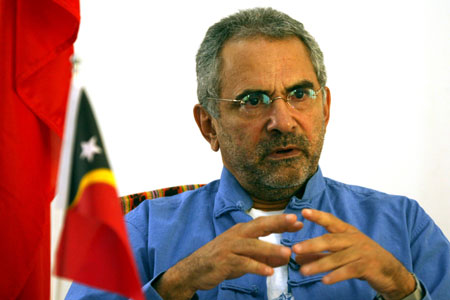
The government, assuming the government was consulted on this, has been poorly advised. Poorly advised in the sense of Jose Ramos Horta is not the man on this one. He is not Timor Leste. It is time that the Australian government showed a little more respect to a sovereign neighbour. It is worth remembering that Timor Leste is an independent nation with considerable resources and considerable income streams that will come on line over the coming years and decades with the exploitation of oil and gas resources in particular.
That is not to say that the new independent nation that is Timor Leste is thriving and economically stable or aid free. However, the people of Timor Leste have done more than enough to earn a little respect in terms of being consulted on the establishment of an asylum seeker processing / detention facility on their sovereign territory.
The proof of the pudding with respect to the poor advice and the poor consultation mechanisms is that Julia Gillard PM, has come out and said to the effect, 'if Timor does not agree then we will find somewhere else!' Perhaps, Nauru, Ms. PM?
I am still waiting for a talking political head to make a valid case on how this is different to the Pacific Solution that John Howard came up with and that Labor so consistently slammed as being in breach of our international obligations and an affront to our collective humanitarianism. So, much so when I watched Alexander Downer articulating on national television pretty much the same things as I was thinking. And, I am sure many millions of other Australians were thinking too!
Therefore, the arguments have to be that the Liberal policy was fundamentally the right one and the adoption of the Timor Solution is Labor's way of saying so or alternatively the policy is seriously flawed and no matter which way you wrap it it still stinks. My humanitarianism tells me that the latter is the correct assumption. No matter how you package it, it still stinks.
This is not about queue jumpers or terrorists sneaking into Australia. The system will 99 times out of 100 pick up on those individuals and exclude them. This is about doing what is right. Right for Australia and right for those fleeing persecution and other dangers that allow them to claim refugee and asylum status legitimately.
A final point. It is about time someone published the numbers. You know, did the number crunching and some projections and gave it to us, the Australian people, how it really is. I heard earlier today on the idiot box (aka TV) that the numbers were something along the lines of a MCG (Melbourne Cricket Ground) every 10 years or so as the total number of refugees and asylum seekers Australia would receive and process. Apparently, our legitimate migration numbers far-exceed this. So, it is not like refugees and asylum seekers are going to do us in economically, socially, legally or any other -ly.
It is time that we as constituents said to our politicians, "this is not a political issue, it is a humanitarian one." And we should add that, "if you want my vote you will act on your humanitarian conscience and not your political one".
Thus endeth the sermon on asylum seekers and the Timor Solution (for today at least!).
Musings about the law, politics, culture, people, education, teaching and life. An independent voice and an independent perspective - Carpe Diem!
Showing posts with label Timur Timor. Show all posts
08 July 2010
25 July 2009
Balibo -- The Film
Here is something that is sure to get under the skin of the members of Commission I of the House of Representatives (DPR) in Indonesia, Balibo. Commission I has responsibility for matters relating to defense, intelligence, foreign affairs, telecommunications, and information. Just about anything remotely related to the Indonesian and Australian bilateral relationship that is probing of Indonesia or her past is dismissed as foreign interference in Indonesians sovereign affairs.
The film Balibo is about five journalists (Greg Shackleton, Tony Stewart, Gary Cunningham, Brian Peters, and Malcolm Rennie) who were either murdered or killed in the cross-fire between Indonesian troops and Timorese rebels. Primarily the focus is on the relationship between Roger East and Jose Ramos Horta. East was later captured and executed, reportedly by firing squad, by Indonesian soldiers. This happened during Indonesia's invasion of the former Portuguese colony that ultimately led to Portuguese Timor being integrated into Indonesia as East Timor.
Aside from the justice that the Balibo Five deserve, Roger East also deserves to receive justice. Journalists must not be cold-bloodedly murdered by invading and occupying forces. More than that, journalists must not be targeted and murdered in the course of pursuing their profession.
This invasion led to the Timorese suffering for the next 24 years at the hands of a greedy colonizer with an insatiable appetite for natural resources and violence. History was only set right with the direct ballot of 1999. Unfortunately, this was not an entirely peaceful transition from colonization to independence.
East Timor has now become the independent Timor Leste.
The film has premiered at the Melbourne International Film Festival where the current Timor Leste president and former rebel leader, Jose Ramos Horta, spoke about his knowledge of the events of 1975. His comments make for interesting reading and are more likely to strain the Timor Leste and Indonesian bilateral relationship than the fact that Australian film makers have gone about making this film.
Interestingly, the Melbourne International Film Festival website has been hacked purportedly by Chinese hackers critical of the festival's decision to screen a film about the violence perpetrated by the Chinese state against the Uighurs. Here is the link (not sure if it is still hacked and displaying the Chinese flag).
According to Ramos Horta, who is known for being very blunt in his assessment of most things, has said that the killings were not an accident nor did they occur in a cross-fire situation. To the contrary, according to Ramos Horta, the five journalist were tortured and then killed.
It is worth noting that Australia was the only country to recognize Indonesia's sovereignty over Timor Leste. It is also worth noting that the governments of Australia and the United States of America were complicit in the invasion as both gave the green light to Soeharto and his bunch of not so merry marauders to go about their invasion business.
Many are looking to see whether the film will put a strain on bilateral relations, it won't but it probably should! Now, whether or not it should is a different question altogether. Yet, if the most recent statements coming from the Indonesian Department of Foreign Affairs is anything to go by, then it is unlikely that there will be any significant impact on the relationship.
Teuku Faizasyah, is quoted as saying that to all intents and purposes this issue has been settled and the accepted explanation of the deaths are that the five journalists were killed in the cross-fire between Indonesian soldiers and Fretilin rebels. Simply, "they were in the wrong place at the wrong time." It is hardly surprising that the Indonesian government is dismissing the film as fiction and the vivid imagination of film makers.
What will be really interesting is whether or not the film gets past Indonesian censors and is shown in Indonesian theatres across the breadth of the archipelago. This is interesting because Faizasyah is also reported to have said that the Indonesian government is not into banning films as this would kill the film sector. This is certainly a different position from that which was adopted in the past.
My personal opinion is that they were murdered and that those responsible, the majority of whom are still alive, must be held accountable for their actions. On the bilateral relationship front between Indonesia and Australia, the relationship is likely to come under pressure if the Australian government was to get some testicular fortitude in the aftermath of the screening of the film and pursue the NSW Coroner's findings about who was responsible and what action should be taken (I have written about this here).
The reason I don't think that this film will unduly strain bilateral relations is that I do not believe that my government has the testicular fortitude, at this point in time, to pursue this. This makes me sad, if for no other reason that it proves the saying, "that the first casualty of war is truth".
I have not seen the film yet. I cannot get down to Melbourne for the festival. However, as soon as I get the chance to see it in Sydney, I will. I will then write a review of it and post it on the blog.
For now, I attach the Official Trailer (available on YouTube) for your viewing (dis)pleasure.
The film Balibo is about five journalists (Greg Shackleton, Tony Stewart, Gary Cunningham, Brian Peters, and Malcolm Rennie) who were either murdered or killed in the cross-fire between Indonesian troops and Timorese rebels. Primarily the focus is on the relationship between Roger East and Jose Ramos Horta. East was later captured and executed, reportedly by firing squad, by Indonesian soldiers. This happened during Indonesia's invasion of the former Portuguese colony that ultimately led to Portuguese Timor being integrated into Indonesia as East Timor.
Aside from the justice that the Balibo Five deserve, Roger East also deserves to receive justice. Journalists must not be cold-bloodedly murdered by invading and occupying forces. More than that, journalists must not be targeted and murdered in the course of pursuing their profession.
This invasion led to the Timorese suffering for the next 24 years at the hands of a greedy colonizer with an insatiable appetite for natural resources and violence. History was only set right with the direct ballot of 1999. Unfortunately, this was not an entirely peaceful transition from colonization to independence.
East Timor has now become the independent Timor Leste.
The film has premiered at the Melbourne International Film Festival where the current Timor Leste president and former rebel leader, Jose Ramos Horta, spoke about his knowledge of the events of 1975. His comments make for interesting reading and are more likely to strain the Timor Leste and Indonesian bilateral relationship than the fact that Australian film makers have gone about making this film.
Interestingly, the Melbourne International Film Festival website has been hacked purportedly by Chinese hackers critical of the festival's decision to screen a film about the violence perpetrated by the Chinese state against the Uighurs. Here is the link (not sure if it is still hacked and displaying the Chinese flag).
According to Ramos Horta, who is known for being very blunt in his assessment of most things, has said that the killings were not an accident nor did they occur in a cross-fire situation. To the contrary, according to Ramos Horta, the five journalist were tortured and then killed.
It is worth noting that Australia was the only country to recognize Indonesia's sovereignty over Timor Leste. It is also worth noting that the governments of Australia and the United States of America were complicit in the invasion as both gave the green light to Soeharto and his bunch of not so merry marauders to go about their invasion business.
Many are looking to see whether the film will put a strain on bilateral relations, it won't but it probably should! Now, whether or not it should is a different question altogether. Yet, if the most recent statements coming from the Indonesian Department of Foreign Affairs is anything to go by, then it is unlikely that there will be any significant impact on the relationship.
Teuku Faizasyah, is quoted as saying that to all intents and purposes this issue has been settled and the accepted explanation of the deaths are that the five journalists were killed in the cross-fire between Indonesian soldiers and Fretilin rebels. Simply, "they were in the wrong place at the wrong time." It is hardly surprising that the Indonesian government is dismissing the film as fiction and the vivid imagination of film makers.
What will be really interesting is whether or not the film gets past Indonesian censors and is shown in Indonesian theatres across the breadth of the archipelago. This is interesting because Faizasyah is also reported to have said that the Indonesian government is not into banning films as this would kill the film sector. This is certainly a different position from that which was adopted in the past.
My personal opinion is that they were murdered and that those responsible, the majority of whom are still alive, must be held accountable for their actions. On the bilateral relationship front between Indonesia and Australia, the relationship is likely to come under pressure if the Australian government was to get some testicular fortitude in the aftermath of the screening of the film and pursue the NSW Coroner's findings about who was responsible and what action should be taken (I have written about this here).
The reason I don't think that this film will unduly strain bilateral relations is that I do not believe that my government has the testicular fortitude, at this point in time, to pursue this. This makes me sad, if for no other reason that it proves the saying, "that the first casualty of war is truth".
I have not seen the film yet. I cannot get down to Melbourne for the festival. However, as soon as I get the chance to see it in Sydney, I will. I will then write a review of it and post it on the blog.
For now, I attach the Official Trailer (available on YouTube) for your viewing (dis)pleasure.
Subscribe to:
Posts (Atom)